

On Beginning Again
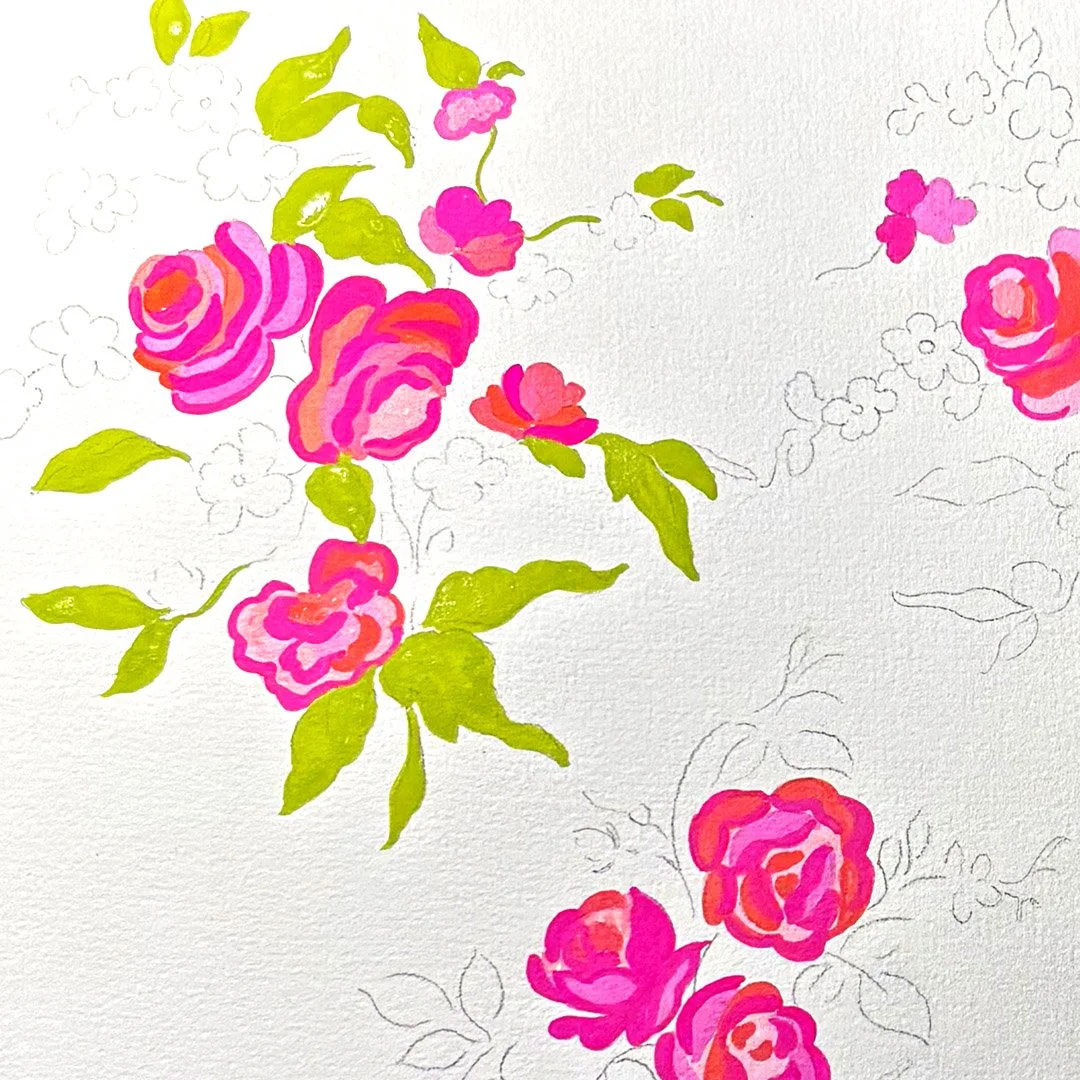
There was no business plan, no mood board, no carefully constructed launch strategy. There was a snowy evening in Toronto, my art supplies, some roses, and eight hours that disappeared without my noticing. Here's what I've learned about creative instincts: they don't leave you. They just get polite. They sit quietly in the corner of your life.
What came back was a way of seeing I had learned young and then set aside without quite meaning to. The grammar of patterns and textiles. The way color deepens as it pools at a petal's edge. The intelligence of repeat: how a single painted form, placed and rotated and placed again, becomes something alive, something that breathes differently than the original. I thought I was learning a discipline. What I was really learning was how to pay attention.
I was reading Mary Oliver then, and her words kept finding me at exactly the right moment. She wrote about nature and the quality of morning light with the same slow devotion a textile designer brings to how a pattern will move across cloth, and in reading her, I began to understand my own impulse more clearly. That showing up for the things that genuinely move you, was both a discipline and a gift. Flowers stopped me. Cloth stopped me. The moment when a painted petal becomes a repeat and a repeat becomes something you can carry with you, that has always stopped me.
The Square grew from that evening.
Each piece begins on paper, still and quiet, a painted floral built slowly, layer by layer. Summer yellow. Lavender. Oxblood deep as old wine. Then the painting travels: tested, scaled, considered for how it will move. What happens on cotton is different from what happens on paper. The flowers soften. They carry differently. The colour shifts in every fold of light.
Firae exists because returning to one's original language is not indulgent. It is necessary. Because on a winter evening the roses asked to be painted, and I had learned enough from Oliver to know that when something calls you, the only honest response is to begin.
It is a slow, evolving body of work, and this, right now, is the first edition.
That felt like enough to begin.
